Showing posts with label beautiful. Show all posts

Tuesday, 16 July 2013

'Fruitvale Station' arrives, and thoughts turn to Oscar

/img-51e48aaa/turbine/la-la-et-0711-fruitvale-station-05-jpg-20130715/600
'Fruitvale Station' arrives, and thoughts turn to Oscar
You may have missed it for the racket produced by the majority of movies currently going boom-boom — or, in the case of "The Lone Ranger," bust-bust — at the multiplex. But with the arrival of Sundance Film Festival sensation "Fruitvale Station" in theaters, the opening bell for Oscar season has sounded, providing welcome news for moviegoers immune to the charms of unnecessary reboots and bloated tent-pole movies. And though we're still a long way from sending the tux to the dry cleaners to see what they can do about the stain left from Wolfgang Puck's pork belly dumplings, it's never too early to begin crafting an Oscar campaign. Several recent best picture nominees — "The Tree of Life," "Midnight in Paris," "Inception," "The Kids Are All Right," "Winter's Bone" and, this year, "Beasts of the Southern Wild" — debuted theatrically by early July. The challenge, which "Fruitvale" must now meet, is to keep the movie and its talent in the conversation as the pages of the calendar (but not the leaves ... this is L.A.) turn. OSCARS 2013: Winners/nominees list | Highlights "Fruitvale" dramatizes the last day in the life of Oscar Grant, a 22-year-old ex-con detained and killed by transit policeman on a train platform in Oakland on New Year's Day 2009. It won both the Sundance festival's Grand Jury Prize and Audience Award, as did Benh Zeitlin's boisterous "Beasts" in 2012. Now, backed by the awards-season muscle of the Weinstein Co., the critically acclaimed "Fruitvale" will again try to match "Beasts," which, after an early summer theatrical run, went on to garner four Oscar nominations: picture, director, lead actress and adapted screenplay. "This will not be the last time you guys walk to a podium," Sundance jury member Tom Rothman told "Fruitvale" writer-director Ryan Coogler in January. That may be true, though at 84 minutes, the powerful, immersive "Fruitvale" might appear a bit slight for some motion picture academy members who equate dramatic heft with running time. But "Fruitvale" certainly got off to a promising start at the box office, averaging almost $54,000 per screen in limited release, a dazzling number. With its obvious connections to the Trayvon Martin case, the film seems poised to turn into an indie hit, which never hurts when it comes to awards voters. At the very least, "Fruitvale" and its accomplished lead actor, Michael B. Jordan, seem destined to succeed at the Film Independent Spirit Awards, though even there voters have been more inclined in recent years to reward established filmmakers at the expense of newcomers like Coogler. With its festival pedigree, "Fruitvale" is the highest-profile awards-season contender to debut this year. But it's far from the only one. Discriminating moviegoers have had to do some serious sifting, but the first half of 2013 provided a fair number of films and performances worthy of being remembered come ballot time. Here are six to file away. Oscars 2013: Best and worst moments since 2008 Actress: Greta Gerwig, "Frances Ha." Academy members, perhaps feeling the pang of self-recognition, don't respond particularly well to kooky characters, which makes Gerwig's lively comic turn in a movie she co-wrote with director Noah Baumbach even more of a long shot for an Oscar. But Spirit voters nominated her for Baumbach's 2010 bittersweet comedy "Greenberg" and should put her at the front of the line for her delightful performance here, arguably a career high point. Supporting actor: Sam Rockwell, "The Way, Way Back." Academy members also snooze on the funny, but Rockwell's work as the sympathetic mentor in this coming-of-age tale is so special and deeply felt that it's possible they just might ... OK .... we're probably kidding ourselves. But beyond Rockwell's inspired comic riffing, there's that beautiful, loving, end-of-film exchange with young Liam James that leaves audiences in puddles. Distributor Fox Searchlight should sell that and maybe send out a case of sunscreen to critics' group members, who tend to be on the pale side to begin with. Supporting actor: Matthew McConaughey, "Mud." McConaughey fought his way back into critics' good graces last year through fine work in "Magic Mike," "Bernie" and "Killer Joe." He's even better in "Mud," playing a charismatic fugitive returning home to reclaim the love of his life. Beyond that, the resurgent McConaughey has a starring turn in "Dallas Buyers Club," a fact-based drama about a man who begins smuggling alternative medical treatments after being diagnosed with HIV. McConaughey lost 30 pounds for that role, which, if the film (and history) holds up, almost guarantees him an Oscar nomination. But "Mud" shouldn't be forgotten. If "Dallas" is all that, how about a double-dip: lead and supporting? Adapted screenplay: "Before Midnight." Since the second entry in Richard Linklater's relationship trilogy, 2004's "Before Sunset," received an Oscar nomination for its screenplay, we're guessing a hard sell won't be necessary. But because this series continues to grow richer — and riskier — with each film, perhaps voters could also be persuaded to extend their kindness, recognizing the movie itself and its fantastic leads, Ethan Hawke and Julie Delpy. The film's improvisatory feel is hard-earned and shouldn't be held against the actors. The emotions they summon run deep and true. Documentary: "20 Feet From Stardom." This crowd-pleasing tribute to female backup singers has done well critically and, at least for a documentary, commercially. Its stories of artists struggling to stay true to their craft and remain relevant in an industry that puts personality ahead of authenticity should resonate with voters. Recent rule changes that make it easier for popular docs like this to make the final cut also work in its favor. And yes, there's the singing which by itself could carry it to a nomination. Documentary: "Stories We Tell." Sarah Polley's fearless investigation into the mysteries of her family life might be the year's most intriguing film. Full of warmth and humor and impeccably constructed, it's the latest chapter from a filmmaker ("Away From Her," "Take This Waltz") who has become a remarkably accomplished storyteller. Critics' praise, which began last year at the Toronto International Film Festival, will likely keep this movie in front of voters when groups award their prizes at the end of the year.


news sours  www.latimes.com
Friday, 14 June 2013

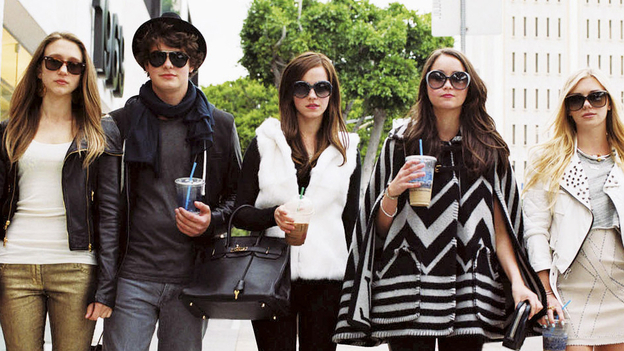
'Bling Ring': When Fame-Obsessed Teens Go Rogue

/assets/img/2013/06/12/the-bling-ring_rgb_wide-b6fa646d9e76a72ddc1d52cdb28cd33635a1b9bc-s4.jpg
'Bling Ring': When Fame-Obsessed Teens Go Rogue
What it came down to in the end were "the beautiful, gorgeous things." That's how Marc (Israel Broussard) explains the Bling Ring, a gang of teens who, over a span of 10 months in 2008 and 2009, robbed a series of celebrity homes, including those of Paris Hilton, Lindsay Lohan and Orlando Bloom. Along the way, they accrued more than $3 million worth of jewelry, clothing, and accessories — not to mention that inevitable tabloid-headline nickname. While Sofia Coppola's big-screen version of their story alludes to celebrity worship and faulty parenting as possible fuel for the spree, she comes back most often to the pull of Chanel and Gucci, and ultimately to Marc's words, delivered in the tone of a person who, even after getting caught, still sinks into a daydream when thinking of the spoils he used to crave. The Bling Ring takes Coppola back to turf she's covered in all her films —the territory of enervating affluence — and the film's best moments demonstrate just how skilled she's become at conveying material longing, even when such yearnings have reached the realm of the perverse. Apart from changing the characters' names, Coppola sticks closely to the details of the Vanity Fair article on which her script is based, starting with the break-in at Bloom's home that would eventually get the group caught and then turning back to the origins of the story, on the night Marc and future ringleader Rebecca (Katie Chang) rob Paris Hilton's home on a whim. Soon, they're joined by a group of girls including the ditzy Nicki (Emma Watson), her adopted sister Sam (Taissa Farmiga), and Rebecca's friend Chloe (Claire Julien). As the story of a gang of four women and one man reveling in a life of manic partying and crime, the film naturally invites comparisons to Spring Breakers. But Bling Ring has none of the overstimulation of Harmony Korine's film, nor does it pride itself on its vulgarity in quite the same way. Its pacing and tone are far from hallucinogenic, staying true to the languid style that has served Coppola well in her previous films. Going back to Lost in Translation — though most prominently in 2010's Somewhere — Coppola has consistently emphasized the ennui that can come with addiction to opulence. In this case, it's the Bling Ring's break-ins that come to feel monotonous. In spite of their daring nature and high-profile targets, Coppola rarely portrays them with any urgency or a sense of danger; one robbery elides into another, as do the parties that follow the burglaries. Banality sets in — as it did in Coppola's Versailles in Marie Antoinette — as Rebecca's rationale for stealing from the next celebrity is reduced to "I like her style" or "I want some Chanel." In her previous films, Coppola mostly reserved judgment on her privileged characters; the same is true, at least to begin with, in The Bling Ring, though the teenagers, with their affected speech and their total disconnect from any reality other than their own, might make easy targets for derision. For the first two-thirds of the film, though, Coppola gives the kids the benefit of the doubt — even drawing out the more charming aspects of their youth. Broussard plays Marc with a near-constant goofy grin, and Watson manages to imbue Nicki with a sweet insecurity that helps balance, and perhaps explain, what can be an annoying petulance. The snag comes in the film's third act, when Coppola leans harder on the story's who-thinks-like that? notes. It's an easy direction to take, as it was for Nancy Jo Sales in her Vanity Fair article; for the most part, the quotes from Bling Ring members do all the work. But the shift in tone feels too much like mockery; the film is most effective when it remains more curious than cynical. In one wonderful sequence, for example, Coppola shows Nicki delicately stroking Lindsay Lohan's jewelry while Rebecca blissfully savors the smell of Lohan's perfume in another room. It's in moments like these — quiet shots marked by emotional exactitude – that the film delivers the best experience. Which is to say that it's when Coppola lets the beautiful, gorgeous things retain their sparkle that The Bling Ring shines most brightly.


news sours  www.npr.org

Friday, 17 May 2013

Many US Women Can't Afford To Do What Angelina Jolie Did

/images/stories/May-2013/cw11040l.png
Many US Women Can't Afford To Do What Angelina Jolie Did
A TAKE ON THE TALK - I did a double take when I saw the headline announcing that Angelina Jolie has recently had a double mastectomy. The woman who has kept stealing headlines for years with her beautiful babies and her beautiful baby daddy, her charitable works and her constantly evolving career was brave enough to put her human vulnerability out there for public consumption in an op-ed in the New York Times titled My Medical Choice. Her goal was to encourage other women at high risk of developing cancer to explore their choices and to take whatever steps may be necessary to save their own lives. Unfortunately the reality for many women in America and elsewhere is that quite often when it comes to making decisions about their health, they often have no choice at all. In her op-ed, Angelina disclosed that she carries the BRCA1 gene that meant in her case that she had an 87% chance of getting breast cancer and a 50% chance of getting ovarian cancer. Having lost her mother prematurely to the disease at a vulnerable time when she had only recently become a mother herself, she was hyper aware of what it would mean for her children to undergo a similar loss. So she took the plunge and made the probably wise decision to have a preventable double mastectomy. As a person with breasts, I can only imagine what a difficult decision this was for her to make, (particularly as her pair have had more than their fair share of attention over the years). She acknowledged that the choice she made was not an easy one, but not one she regrets either, particularly as her chances of developing breast cancer since having the procedure have dropped from 87% to less than 5%. Many women in similar circumstances will no doubt be comforted and encouraged by her experience and her decision to share it. She does have one major advantage over a lot of women dealing with cancer or facing the prospect of developing cancer, however, and this is that for her money is not an object. She didn't mention how much the procedure or reconstruction surgery set her back, but it's safe to assume she got the best possible care and paid top dollar for it. She did allude to the $3,000 fee for the gene test that led her to make her potentially lifesaving decision and pointed out that this cost alone can be an obstacle for many women. It certainly is, particularly as the test is not commonly covered by insurance, but the costs of the mastectomy itself and the reconstructive surgery can also be prohibitively expensive, even for women who have decent health insurance. It's difficult to get an exact estimate of how much such a procedure typically costs because cases vary, insurance packages vary and surgeons' prices vary. Under the Women's Health and Cancer Rights Act (WHCRA), which was signed into law in 1998, most insurance plans that cover mastectomies are required by the law to also cover the cost of breast reconstruction. There are many criteria to be met, however, and there are always exceptions. But even though most cases deemed medically necessary will be covered, women still report having to pay out between $10,000 and $25,000 on co-pays or fees the insurance company will not pick up. Still at least women who do have health coverage have some chance of getting the care they need. For the estimated 21 million women and girls in America who have no health insurance not only are the costs of such a procedure insurmountable, but they even face obstacles from a hostile congress to gaining access to the most basic cancer screening services. Every year, for example, millions of women avail of Planned Parenthood, an organization that offers cancer screening services on a sliding pay scale. In 2011, the organization, such as pap smears and breast exams, which accounts for 12% of their total services. Undoubtedly many cancers are detected early because of these screenings and many lives are saved. Yet two years ago, the House of Representatives approved an amendment (by a margin of 240 to 185) to cut off funding to Planned Parenthood, all because of their objections to the fact that the organization also offers women the legal medical procedure of abortion. Fortunately the bill never made it past the house but the disregard for women's health was painful to observe. The same disregard for women's health and for poor people's health in general was evident in the viscous battle over the Affordable Care Act. Miraculously, it survived the various onslaughts, including a Supreme Court challenge, more or less intact and it should make a significant difference to women's health (pdf). Until now, insurance companies were able to charge women more than men (sometimes 150% more) for comparable coverage and were able to deny women coverage for pre-existing conditions, such as being pregnant. As of 2014, when the act goes into effect, that will no longer be possible. This should mean that in the near future more women will have access to health insurance and more women will be in a better position to avail of regular screenings and breast exams. This could not be more important since the National Cancer Institute estimates that around 12% of women in America will develop breast cancer in their lives. Angelina Jolie has done a great thing by sharing her decision to make a brave choice regarding her health. I'm sure she would be the first person to agree, however, that no woman should be denied that right because of a lack of income or insurance. (Sadhbh Walshe is a film-maker and former staff writer for the CBS drama series The District. Her opinion pieces have also been published in the Chicago Tribune and Irish Times. This piece was posted first at guardian.co.uk)


news sours     www.citywatchla.com